

When working on ventilation projects, a common dilemma faced by procurement professionals and engineers is whether to choose a centrifugal fan or an axial-flow fan. While both types of fans move air forward, they differ significantly in their operating principles, performance characteristics, and ideal applications. Selecting the wrong type can lead to issues such as insufficient airflow, excessive energy consumption, inadequate system pressure, or even long-term equipment operation under faulty conditions. Drawing on over two decades of project experience in industrial ventilation-a perspective provided by Suzhou Yonghecheng Fan-we have outlined the selection logic for both fan types to help you make an informed decision based on your specific requirements.
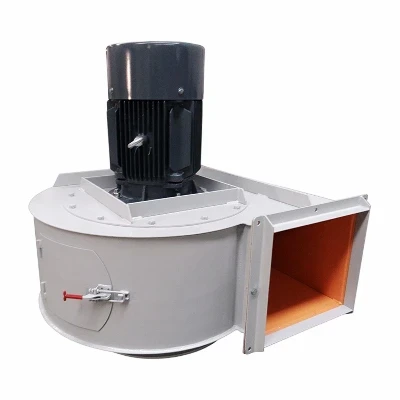
Below is a comparison of their key parameters:
| Comparison Items | Centrifugal fan |
Axial Fans |
| Airflow pattern | The airflow turns 90° and is exhausted outward along a vertical axis. | The airflow is delivered in a straight line along the axis of rotation. |
| Airflow Range |
1000-500000 m³/h |
1000-300000 m³/h |
| Wind pressure range |
150-25000 Pa,Capable of high-voltage output |
Tens to 1000 Pa; characterized primarily by low pressure and high flow rate. |
| Power range |
0.12-1000 KW |
0.37-160 KW |
| Temperature tolerance | Flue gas at temperatures up to 850°C | Standard range: 20–80°C; custom versions available to a limited extent. |
| Available materials | Carbon steel, stainless steel, and aluminum alloy; full range of anti-corrosion and explosion-proof options available. | Carbon steel, fiberglass (FRP), aluminum alloy |
| Key Advantages | High pressure resistance, broad media compatibility | High airflow, lightweight design, simple installation, and lower procurement costs |
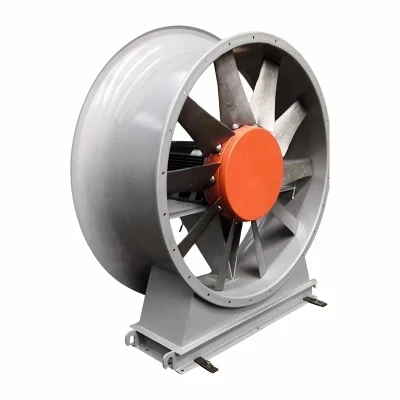
Let's start with the core operating principle. In an axial-flow fan, the airflow enters and exits along the direction of the fan's axis of rotation; the blades act like a propeller, pushing the air forward axially. These fans are characterized by high airflow volume, low pressure head, a simple structure, and a compact footprint.
Centrifugal fans, by contrast, operate quite differently. Once the airflow enters the impeller, centrifugal force propels it outward in a direction perpendicular to the axis of rotation, and a volute casing then directs the flow toward the outlet. A direct consequence of this design is that the fan can overcome significantly higher system resistance, offering a much broader range of pressure heads.
The second factor to consider is the medium being transported. For clean air-primarily for ventilation and cooling-an axial-flow fan is lightweight, cost-effective, and perfectly adequate. However, if the medium contains dust, oil mist, or corrosive gases, or if the operating environment involves flammable or explosive risks, a centrifugal fan-equipped with wear-resistant, anti-corrosive, or explosion-proof features-should be selected.
Third, consider the application scenario. In medical cleanrooms or fresh-air purification units, where high precision in static pressure and airflow control is required, centrifugal fans paired with high-efficiency components are typically used. In oil and gas projects, centrifugal fans are generally employed for long-distance smoke extraction and process exhaust, while axial-flow fans handle general ventilation and cooling for workshops. In agriculture, axial-flow equipment is the primary choice for regulating temperature and humidity in greenhouses or livestock sheds, as well as for drying and dehumidification. In food processing facilities, both types are used: axial-flow fans provide ventilation and cooling at specific workstations, while centrifugal fans are utilized for drying lines, moisture removal, and material transport.
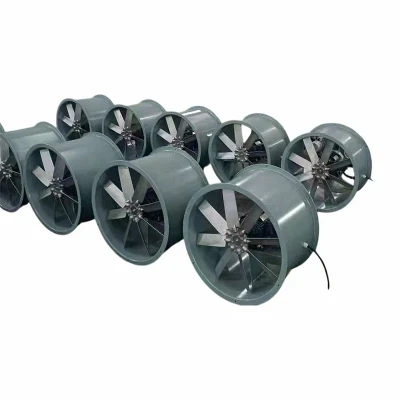
Beyond operating principles and scenarios, several practical parameters must be verified during the selection process. First, calculate the required airflow and system static pressure. Next, determine the appropriate materials for the impeller and housing based on the medium's temperature, humidity, dust content, and corrosivity. Decide on the drive mechanism (direct drive vs. belt drive), assess the need for explosion-proof ratings or variable-frequency control, and account for site-specific constraints regarding noise, vibration, and available installation space. Only by integrating all these factors can a comprehensive fan configuration plan be developed.
Located in Suzhou, China, Suzhou Yonghecheng Fan produces over 50,000 fans annually. Our production lines are equipped with high-precision CNC machinery, laser cutters, and dynamic balancing systems, with every unit undergoing full-scale testing before leaving the factory. Our pre-sales engineers assist with model selection based on your specific project conditions-providing technical drawings and performance data-while our after-sales team guarantees a response to technical inquiries within two hours. If you have any questions regarding fan selection, please feel free to consult with us online at any time!


